Eric’s Story of Sleeplessness and What he Did to Build his Resilience

“I don’t think I’m exaggerating when I say that the Heart Lock-In saved my marriage—and possibly my life,” says Eric, age 35. “A year ago, I started a new company. My wife and 2-year-old daughter and I were the perfect postcard family, complete with my wife’s belly-bump of our expected son. Then, shortly after our new little guy was born, the world pretty much blew up in my face.

We expected a month or two of sleepless nights, which we experienced when our daughter was born. But it was soon clear that this new baby was a whole different story. We started calling him ‘the sleepless wonder.’ We talked to the pediatrician and he told us that it’s more and more common for infants to sleep sporadically and very little.

By the time the baby was six months old my ‘perfect’ life was in tatters. My wife was exhausted, our now-3-year-old was acting out in jealous anger at her brother’s constant intrusion into her world, our once-tidy house was in shambles, and I had dark circles under my eyes that looked like I was back on the football field in college with shiners painted on to catch the sun. I had paced many miles around our living room, all night long, night after night, trying to soothe a crying, restless baby while my wife pleaded with me to let her sleep so she could face the next day. After a while, my body went through a change and I developed a new pattern—the inability to sleep even when I had the opportunity. My new business was floundering and I was too tired to know what to do about it. The stress was taking a toll.

Then a friend turned me on to the Heart Lock-In technique and showed me how to do it. She’s a HeartMath coach, and explained the physiological benefits and gave me a HeartMath music CD called Quiet Joy. When I did my first Heart Lock-In, I fell into what seemed like a coma, that’s how deeply I conked out. She explained that that was natural at first, given my state of fatigue, but that I would soon be more in control.

I tried it some more and within a week, I had a whole new routine for my once sleepless nights. I would take the baby, kiss my wife and daughter goodnight as they settled in for their evening cuddle time together, and go out to the living room. I’d put Quiet Joy on endless loop, and settle my son close to me while I did evening chores and wind-down activities. Then, I’d get both of us ready for bed and lay back with him in my recliner, baby boy on my chest, secure in a sling. I would do a deep Heart Lock-In, radiating love and appreciation for my family—my wife, daughter, and son—and he and I would both drift off.

He’d wake up a time or two in the night, needing a bottle or change. But I wasn’t a sleepwalking zombie anymore. The Heart Lock-In helped me gain an entirely new approach to sleeplessness, and in fact, to life. I’m not kidding—it changed everything for me. My wife and daughter are regaining their balance and I have hope that things will level out for our family again, in a new and better way. I’m more productive in my new business, too. Hard to believe one simple technique could help accomplish all this. But that’s the Heart Lock-In for you!”

Warm Regards,
Eric

One Coach Shares Her Resilience Story Using the emWave® Pro

coherent heart wave

“I’m Bonnie Thompson and I’m a Certified Professional Co-Active Coach and Certified HeartMath Coach. In my coaching practice I specialize in two areas: Resilience and Highly Sensitive Persons (HSPs). I have worked with clients from all over the world for many years, helping them to live more authentic and centered lives.

I became involved with HeartMath® over 15 years ago when I began practicing the tools and techniques to deal with a very stressful time of my life. I have said many times that it was HeartMath that got me through it all.

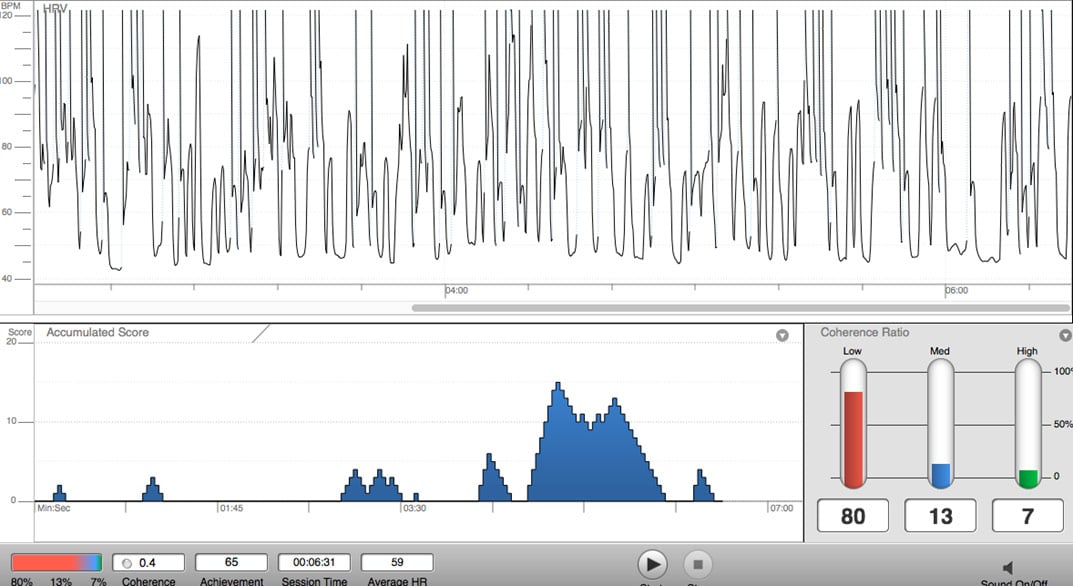
In April of this year I had eye surgery and I was in a lot of pain and not sleeping well. I have occasional benign arrhythmias that get worse the more sleep deprived I become. It’s always been interesting to me that my heart becomes so irregular without good, solid sleep. I think everyone’s body gets very stressed without adequate sleep, and in my case using the emWave® Pro clearly demonstrates this.

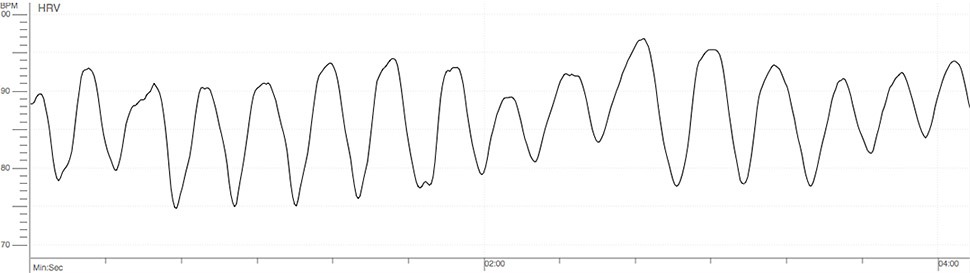
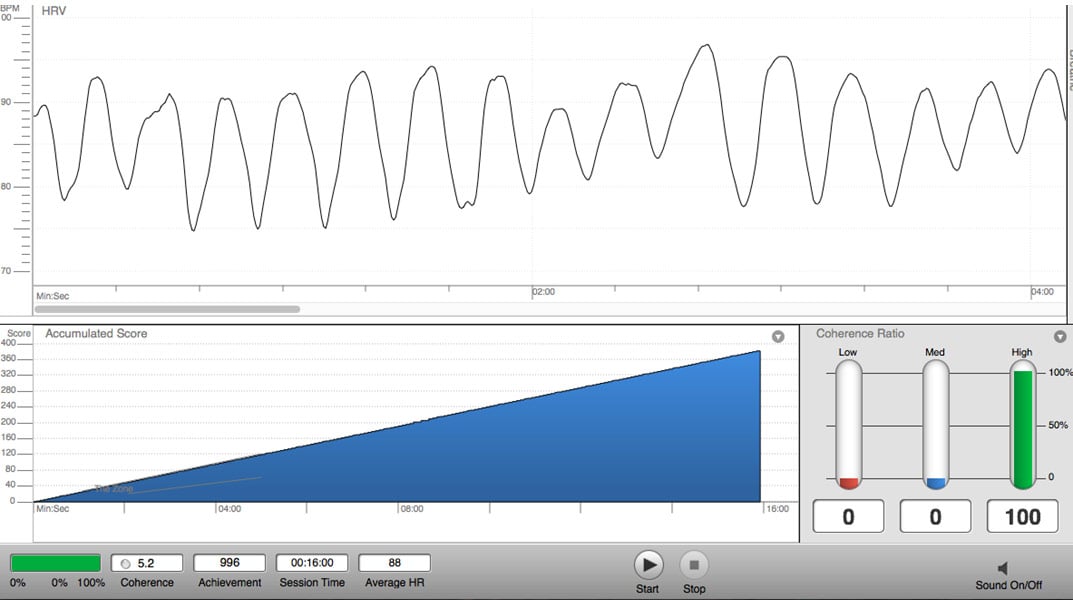
The first graph is a screen shot of my HeartMath emWave session the day after my surgery. Even though I was unable to get into coherence, I persisted. I continued to practice the HeartMath tools several times a day throughout my recovery and a week later my HRV pattern was reflected in the second graph.

Graph 1: emWave session the day after surgery

Bonnie Thompsons unfortunate heart rate variability after surgery

Graph 2: emWave session after a week of use

Bonnie Thompsons improved heart rate variability after using heartmath techniques

These two graphs from the emWave Pro represent two extremes but for me they also represent progress. First, being able to see what lack of sleep does to me was very instructive and I even showed this to my doctor. And second, even though measurable coherence was difficult right after surgery I stuck with the practices. By doing so I believe I was able to speed up my recovery and my HRV reflects that progress. I have been very inspired by this experience and I hope to be able to reduce my incidences of arrhythmias over time. I am so grateful for the HeartMath technologies that allow me to see in real time what is going on in my body, mind and emotions!!

Regards,
Bonnie Thompson

Bonnie Thompsons improved heart rate variability after using heartmath techniques

Interested in Becoming a HeartMath Coach?

Click Here.

Resilience Tips to Refresh our Attitudes

Our mental and emotional resilience helps us to recover from and adapt to stressful situations that can challenge us. Finding inspirational ways that refresh ourselves can make a big difference in our day to day attitudes and increase our natural resilience.

Most people find it more manageable to work with one at a time, moving on to the next until the strategy begins to come naturally.

Resilience Tip #1: Create a Regular Window for Reflection

Use mindful practices like yoga or meditation to tune in to your needs rather than tuning out or shifting your attention. Journaling your thoughts is also a great way to heighten self-awareness and discover what your personal or spiritual needs are. Listen to and honor subtle emotional and physical cues for the greatest insight.


Resilience Tip #2: Learn to go to Neutral

They have relegated circumstances to their rightful place: as short-term conditions that have no power or influence over whom they are in the moment or who they will be when the situation has changed.

The Neutral Tool:

Step 1: As soon as you feel an emotional reaction begins, take a time-out and create some space for yourself to breathe slowly and deeply as you imagine the air entering and leaving through the heart area or the center of your chest. This helps draw the energy out of your head and deflates the reaction.

Step 2: Focus on your heart and breathing instead of stressful thoughts or worry. Declaring and adopting the intention to disengage is very effective in neutralizing emotional energy.

Step 3: Continue until you feel calmness throughout your body and mind. This may not mean your anger or anxiety has totally evaporated; it just means that the charged energy has been removed and stress can stop playing out in your body.


Resilience Tip #3: Feed Your Heart and Soul

Take time regularly to do the things that make you feel centered and peaceful. Create a list of things you know will rejuvenate you, and increase your self-care. For some, it may be spending time in nature a few days a week; others might find pleasure in exploring a creative outlet such as a cooking, painting or music class.

If volunteering is a satisfying activity for you, find the appropriate outlet for yourself and schedule time to give to others. Consider your needs on mental, emotional, spiritual, and physical levels, and alternate with different activities to nurture all facets. For example, an athlete might combine physical exercise with volunteering by coaching a sports team, or anyone interested in learning skills she’s mastered.


Resilience Tip #4: Appreciate the Good

Keeping a gratitude journal is truly a good idea, since it shifts focus to the positive things we appreciate. If you haven’t already, consider starting this enjoyable practice; many people find it’s especially effective in the evening before sleep.

Pay attention during the day to one or more things that trigger feelings of appreciation. Anything and everything can be included, like appreciating yourself for making the effort to bring healthy snacks to work, or noticing when a co-worker does something to help you out. Maybe a total stranger let you cut into the checkout line. Focusing on the many good things in life helps build inner resilience.


Resilience Tip #5: Get a Healthy Tech Habit

Another way to increase resilience is through practicing heart-focused techniques combined with monitoring your heart rhythms – like with the emWave2® and Inner Balance™. Creating a healthy use habit with these tools can really help change your response to stress and boost your resilience. They’re like having a personal coach to guide you through a simple process – encouraging you along the way. These technologies are based on the science of coherence – a resilient mental and emotional state that also helps the heart, brain and nervous system work more efficiently and harmoniously.

The beauty of this practice is how we feel when we are coherent. It’s a feeling of being more alert and energized when needed, yet able to unwind and relax when it’s time to. Most people start with a three minute session in the morning to set a balanced inner rhythm and healthy outlook for the day ahead. Another short session before bed can help prepare the mind and body for a restful sleep.

This is one tech habit you’ll benefit from.

Time to Hit the Refresh Button

A friend of mine picked up a book to help him finally clear the clutter in his office. He placed it at the top of his ‘have to read’ pile and decided to get a head start by sorting through the pile right then and there. Guess what he found when he finally reached the bottom of the pile? The same book!

Most of us have drawers, closets and inboxes, so full we’ve lost track of what’s in them. Not to mention that when they‘re full, there’s no room for new stuff.

Have you ever noticed that as soon as you get rid of what you no longer need or want, new things start to show up?

It’s the same with ideas, beliefs, or emotional attachments. Whatever your threshold (how big is your closet?) is for holding onto old notions or behaviors, once you reach that limit, there’s no room for anything new until you discard some of the old.

Why not attract something new into your life? Pick an aspect of your life ― work, play, family, etc. ― that needs updating or a new energy, attitude or behavior. Then use the Quick Coherence technique to quiet the ‘yea buts, what ifs and just in cases’ and from a coherent perspective ask your heart what to let go.

Be patient and stay neutral until you get an answer. Don’t be surprised or afraid of what pops up. Then let it go, knowing there is now room in your life for new, fun and exciting things.

And, oh yes, this works when you’re ready to clear out those closets, too!

Take care,
Kim Allen

Technology that Helps Build and Sustain Resilience

Howard Martin shares how he uses the HeartMath technology in his regular practice each day to tune up and sustain his resilience. “I have been practicing the HeartMath techniques for a very long time. When we first came out with our technology I used my emWave® most every day to help deepen my practices. For the last few years I have been using my Inner Balance™ app and sensor as I like having the whole experience on my iPhone.

I have found that using my Inner Balance has really helped me be more productive in my meditative practices and to “tune up” during my busy days. It has greatly improved my use of techniques to help me grow and deal with challenges. Basically, I have built my Inner Balance experience into my day-to-day life in a systemic but casual way. Here is how I use it.

In the morning after dressing, showering, etc. I allot 15 minutes to doing my Heart Lock-In, a HeatMath technique designed to activate and sustain positive emotions. I sit on my bed with the Inner Balance sensor attached to my ear and start the technique. I play a game with this.

In the Inner Balance app there is a screen called Session. On this screen I can see several things:

  • My heart rate variability pattern
  • Coherence—my coherence level in the moment
  • Length–how long I have been using the app
  • Achievement—how many coherence points I have earned

These numbers change every 5 seconds while using the Inner Balance. At the end of the session I go to the Review Screen where I can see my average Coherence Score and how many Coherence Points were achieved during the time I was using the Inner Balance.

Here is a simple analogy to understand the Coherence and Achievement Scores. The Coherence Score would be like seeing how fast you are going if you were driving a car. The Achievement Score would be how far you have gone. The more coherent my heart rhythms are the higher my coherence score and as a result more achievement points. My goal is to really do my Heart Lock–In with sincerity, get as high an average coherence score as possible and accumulate as many points during the session as I can.

Having done this many times I know what a normal averages would be for a session. I know when I am improving and when I am not. This whole process keeps me honest and really does help me get the most out of my inner work time.

I repeat the same process most days right after lunch but for only 5 minutes. This helps re-boot my system for the rest of the day. I also do it again at night after my work day ends and before I go to sleep. The length of this session depends on a number of things so I let it be a bit more flexible. It usually ends up being between 15 minutes and 30 minutes.

Now, here is one more aspect, the Inner Balance feature that makes it extra fun. All of my sessions are stored on the HeartCloud™. There I get a great picture of my seasons and for me most importantly, how many Achievement Points I have accumulated over the life time of using my Inner Balance! With this information I can set goals. I can say for instance that if I want to get 25,000 Achievement Points this month. I note the life time number at the beginning of the month, track how I am doing towards reaching my goal and make a fun game out of it. This self-monitoring game motivates me to make sure I am using my Inner Balance and doing my focused inner work each day.

In summary:

  • I build using my Inner Balance into my daily routine
  • I use the Session Screen to see what is happing while using the Inner Balance—Coherence Score and Achievement
  • I look at the Review Screen to see my Coherence Score Average
  • I look at my sessions in the HeartCloud to track progress/results and to set and work towards goals

This is how I use HeatMath’s Coherence Building Technology. I suggest you create a system for using your Inner Balance or emWave that works for you. What I can say is that without a doubt it has benefited me greatly and I hope it can be of help to you as well.

Resilience Building Tools for College Students

Ahhh college…some view it as the best time of their life while others as the most challenging and uncomfortable. Whichever way you remember it, stressful probably isn’t how you would describe it. Today college students are under a tremendous amount of stress. The American Academy of Pediatrics reports that colleges are seeing a generation of students who appear to be manifesting increased signs of depression, anxiety and stress. Managing stress is a learned ability and learning to manage college stress while building resilience will carry them a long way over their lifetime.

To help your child learn to manage the pressure, here are some things you can do:

1

Shift to Ease at the Onset of Stress. Learning to shift to a state of inner ease at the onset of challenging situations can help prevent and eliminate many unwanted predicaments. The Inner-Ease technique will make it easier for your college student to navigate through many challenges. Have them practice it a few times each day for several weeks, so it will become a natural part of the daily routine.

target

Step 1: Heart-Focused Breathing

Focus your attention in the area of the heart. Imagine your breath is flowing in and out of your heart or chest area, breathing a little slower and deeper than usual.

Suggestion: Inhale 5 seconds, exhale 5 seconds (or whatever rhythm is comfortable).

lungs

Step 2: Draw in the Feeling of Inner Ease

With each breath, draw in the feeling of inner ease to balance your mental and emotional energy.

anchor

Step 3: Anchor and Maintain the Feeling

Set a meaningful intent to anchor the feeling of inner ease as you engage in your projects, challenges or daily interactions.

2

Take advantage of HeartMath’s resilience building technology:

Inner Balance™ App and Sensor for iOS & Android devices- a fun and innovative approach to de-stressing and improving wellness. It helps you change your reaction to stress, gain insights in your shifting moods and create a more positive outlook on life.

emWave® Pro – The emWave Pro is a scientifically validated hardware/software system that teaches techniques to help you manage stress through creating an optimal state in which the heart, mind and emotions are operating in-sync and balanced.

Good for the Mind, Body & Soul

Someone once told me while I was in the midst of a difficult situation, if there’s the slightest chance you might look back on this some day and laugh about it, start laughing now. Granted, this doesn’t work every time, but it sure has helped me get through some tough times. Seeing the lighter side is a perceptual shift. And just like other positive emotions that can change the way we see something, laughing has a lot of other benefits.

Studies on humor and laughter from Duke University, Loma Linda University, UCLA, and even from other countries such as Great Britain have shown:

  • Laughing helps relax tense muscles.
  • Laughter reduces the production of stress hormones.
  • Laughter and a positive attitude strengthen the immune system.
  • Laughter allows a person to ‘forget’ about aches and pains and perceive pain as less intense.
  • A good laugh is like an aerobic workout for the heart and lungs–increasing the body’s ability to use oxygen.
  • Laughter helps lower high blood pressure.
  • There are no known negative side effects to laughter.

Laughing is part of the human experience. New research shows that “circuits” for laughter exist in very ancient regions of the human brain. Robert Provine, a psychology professor at the University of Maryland in Baltimore, tells us, ” (Laughter’s) origin is in tickling and rough-and-tumble play. Laughter is literally the sound of play… (which becomes) the human ‘ha-ha.’ (1)

Maybe that’s why children laugh over 300 times a day. It’s natural. Surprise, surprise: That number falls to 15 with adults. Unlike children who laugh unconditionally, we adults wait to find cause. Which brings up another one of those which-came-first conundrums: Do we grow old because we stop laughing? Or, do we lose our ability to laugh because we grow up?

Whatever, laughter not only feels good, it’s good for us.

Stay young…and healthy. Add more laughter to your day!

(1) Animals Laughed Long Before Humans, Study Says – NationalGeographic.com

Take care,
Kim Allen

Back to School – Resilience Tips for Kids

We all know how badly we react to nonstop stress, why would we expect our children to be any different? All this pressure isn’t resulting in better performance or higher test scores. In many cases it is leading to anxiety, depression and an overall feeling of sadness. The good news is that it doesn’t have to be this way. There are things you can do with your children to help alleviate this stress response and increase their resilience.

To help your child learn to manage the pressure, here are some things you can do:

Exercise

Research shows that exercise is key to proper brain development and reduces stress. Daily activity is very important.

Diet

A balanced nutritional diet is important when it comes to focus and energy. Make sure your child gets a good breakfast, lunch and a balanced dinner.

Sleep

Enough sleep is very important in the fight against stress and helping to build their resilience. The amount of sleep students get at night has a direct impact on their performance at school during the day. According to classroom teachers, elementary and middle school students who stay up late exhibit more learning and attention problems.

Teach children about positive ways to cope with stress.

The Inner Balance™ app and sensor for iPhone, iPad and iPod Touch is a fun and engaging way to build and sustain emotional resilience.

emWave2® or emWave® Pro have games that can teach children how to focus on their heart as they master visual challenges.

3 Life Hacks for Creating Emotional Resilience

Increasing resilience will amplify the intensity and duration of positive emotional experiences. The desire for ease, enthusiasm, and pleasurable life experiences are universal, and will serve you well in dealing with all types of challenges, from financial or career concerns to interpersonal relationships, health issues and inconveniences.

Choose the Right Attitude

When we start a new day, it is a good practice to take a few moments and get still inside, before the flurry of the day really kicks in. Still the mind and focus on the heart. Ask, “How would I like my day to go?” Then ask, “What attitude would help me to align with this intention?”

Once the attitude is in focus, and we’re really feeling it, breathe that feeling associated with the intended attitude for a couple minutes. Carry this attitude throughout the day. When possible, take a brief break to refresh the intention and the attitude.


Keep a Sense of Humor

When our days get busy and we’re juggling a lot of responsibility, we can sometimes lose sight of humor and our lighter side. Humor allows us to put life into perspective. When we feel weighted down by the day, it is good to check in with ourselves to see if we’re using more mind than heart. If so, try to create a small window of time (try this on a lunch break or during an afternoon break) to allow the mind to get quiet and to rebalance the partnership between our mind and heart.


Avoid Drama

Drama and over-significance bleeds our energy reserves. It can often happen when we’re repeatedly turning over thoughts about what someone said or something that happened that didn’t suit us. Each time we replay these thoughts, or continue talking about a scenario that wasn’t ideal, we’re adding energy to it.

The question to ask ourselves is whether or not this is where we want to spend our energy. Is it something we can really let go of, and move on? Or, if it is something deeply concerning, try to set it aside the best you can until you can have a productive discussion. Talk with someone you know will listen and that can provide honest input to help find the clarity needed in order to move forward.

Stepping Away From Your Blind Spot

When visiting my 85 year old father last week, I took it upon myself to organize his apartment. The next day everything was back in its original spot. There’s comfort in the familiar and comfort was certainly more important to him than a new, more efficient place for his mail.

We all know other people who are stuck doing the same things the same way. Yet we fail to see our own narrow views or the “I know what I know” attitudes we hang on to, never considering the possibility that we may be wrong and there is be a better way.

The world around us is rapidly changing. Flexibility and adaptability are critical success factors. Although openness to new ideas and a sincere desire for positive change are more important than ever, we often stay with the familiar assuming it will continue to produce the desired results.

Albert Einstein said it best: “The significant problems we face today cannot be solved at the same level of thinking we were at when we created them.”

We miss opportunities because the discomfort we feel around change–fear, anxiety and worry–can literally limit the brain’s ability to see other options. This means if we want to think differently, we have to first feel differently.

Next time you hear yourself saying, “I know what I know”, make sure you aren’t blind to other options. Start by getting Neutral: focus on the area around your heart; breathe in and out through the heart. Then engage the power of the heart by feeling a positive emotion. The physiological change brought about by this emotional shift will enhance brain function and allow you to view the issue in a whole.


Take care,
Kim Allen