Although the pandemic and global protests have created unprecedented levels of stress and anxiety, an awakening of the heart has also taken place. More people are realizing we cannot return to the old normal, rather we need to co-create something new. There are many levels of awareness and perceptions throughout collective humanity. Our minds may be different based on beliefs, upbringing and life situations, but our hearts can find harmony with each other in a shared existence, if we desire this.
It’s in the heart that we access the core qualities of love, compassion, care, kindness, forgiveness and appreciation that lift us above separation, judgment and blame. More people than ever have been experiencing and expressing an abundance of these enriched heart qualities over the past few months, recognizing that this is who we truly are. Through intentionally demonstrating these heart qualities in our lives, we have a unique opportunity to continue an awakening of our heart’s natural, compassionate care and desire to create the future together in harmony. Yes, it takes a little energy to practice, but not as much as it takes to recoup from the stress and health problems that accrue from not including our heart’s qualities and guidance in our interactions and choices.
Many people are feeling convinced that if we return to the old normal, then life’s stepped-up challenges and restrictions will become the new norm. However, more and more people are inclined to believe it’s highly possible that we can create something new. Increasingly, much of humanity is feeling in their hearts that we need to start treating each other and our Earth with more care, compassion and respect. This could become our newest discovery in energy economy (once understood).
There are enough people awakening to prevent attitudes and perceptions from receding all the way back to where they were before the virus. It’s our individual and collective responsibility to maintain this heart momentum and let it become our baseline for creating and thriving in a world of increased peace, fun and fulfillment. Love can create such things, yet we have to choose it.
Let’s each commit to a practice of replacing standard reactions of judgment, blame and separation with compassion, kindness and cooperation for the good of the whole – and our own peace. Managing our mental and emotional energies, moving with foresight, and putting out more compassion and kindness at this time will help to continue the activation of increased heart energy throughout humanity – a key purpose of the shift that is occurring. Together, let’s seize this obvious, unprecedented opportunity to co-create a new normal – a world in which it’s common sense to be benevolent and cooperate with each other for the highest good of all.
My friend and longtime supporter and friend of HeartMath, Gregg Braden, has a new book out. It’s titled The Wisdom Codes, and I want to share my impressions of it with you.
In many of Gregg’s works, he speaks about the truth and power taken from ancient traditions and gives this information new meaning and relevance in today’s times. This theme is carried forward in his new book, but his approach in The Wisdom Codes is certainly a bit different for him and his readers.
In The Wisdom Codes, Gregg shares and analyzes carefully selected pieces of scripture, parables and quotes from ancient cultures: Hindu, Egyptian, Christian and more. The content he has chosen to study relates to many challenges we all face like Fear, Loss, Protection and Love.
He then brilliantly breaks down the linguistics and the deeper meaning of each one, each Code. In essence, he decodes them, exposing the true power of what has been shared with us for thousands of years through the greatest spiritual traditions. What I especially like is that he then takes it a step further by showing the reader the Code and how to practice and use it to create change.
Throughout the book, being the scientist that he is, Gregg provides interesting scientific information and new understanding about the power our words have in how we think, feel, perceive and shape our individual and collective worlds.
This is a lovely, compact book. The Codes and the information about each one are presented and organized clearly so you can easily get to the information you want, making it easier to practice and apply the learning.
The Wisdom Codes gave me a new understanding about what we have been taught through the writings of great, intuitive, aware people who lived and shared long before us and how their words can provide valuable guidance and insight needed for humanity to take its next steps into a new and much better world.
Hats off to Gregg for another great book that I am sure will benefit many people!
We are providing a Special Care Focus 2 because people are asking
us for our insights into the higher values of
the coronavirus for humanity and for more helpful suggestions on what they can
do.
The coronavirus pandemic is awakening multi-millions to the
reality of our interconnectedness. The virus doesn’t discriminate race,
nationality, religion, political beliefs or financial status. We are all in
this together, which can turn out to be the bright side of it all. Millions are
isolated by “shelter in place” or separated by “social distancing,” yet sensing that
it’s now time to care for each other more than ever. At the same time,
people report feeling lonely in social isolation but using the time to slow
down, go deeper into reflection, and reach out online to connect with family,
friends and social groups. Collective online participation of people sharing
and sending heart and compassion lifts our spirit while boosting our
confidence, immune system and resilience.
The rise of the human spirit is in the air, along with high
anxiety and insecurity from uncertainty. That’s understandable. As individuals
and countries collaborate, while releasing blame
and separation, humanity will increasingly realize the power of collective
heart intention for drawing to us the best outcomes for present and future
situations.
Many people are sharing that
they strongly sense from within, that life is calling for the next
level of care and authentic connection with each other. Caring and heart-felt interactions help
to offset stress accumulation from anxiety, fear or panic, while clearing our
mind for effective reasoning, especially when confronted with health, financial
or other challenges.
Increasing our kindness, compassion and cooperation will eventually be realized as highly intelligent and
efficient street sense, not just spiritual disciplines. The new
spiritual is to bring these qualities of the heart to the street in our
interactions with each other. Most of us feel we want more harmonious
interactions, but we have to step into it with our heart’s intention in
order to change the old habit imprints. We can, and will,
eventually do this — it’s who we are. Sometimes life nudges us more firmly to step
into choices that are the best for us and the whole. Our hesitancy is part of
the old human nature, yet we are moving into the new natural as
the collective heart of humanity continues to open.
Compassion, helpfulness and cooperation feel
natural in our present challenges. That’s because they are natural to us.
The objective for humanity is to sustain this genuine care without needing
stress to remind us. This will activate next level consciousness. The
door is wide open for a fresh start. Solutions are within our hearts. Caring for
each other is what increases the connection with our heart’s intelligent
guidance and solutions – a secret that’s been hidden in the open all along.
Care Focus – Rise of the Human Spirit
(1 thru 5 can be used together
or do a different one each day for as long as you feel. This can be helpful
anytime.
1. Breathe
feelings of peace and love through your heart area for a few minutes to
set a calm and genuine tone.
2. Feel your heart connecting with others who
are sending compassionate care to all who are suffering the challenges of this
virus. See the power of the collective amplifying the effectiveness of your
care.
3. Let’s send our most sincere
appreciation, love and compassion to all the front-line providers and those
helping behind the scenes while risking their lives. See them
surrounded by love, compassion and resilience as they serve selflessly.
4. Now, envision the coronavirus inspiring deeper
connections among people and more harmonious cooperation for the good of the
whole. See humanity transitioning into the crucial importance of love, compassion,
cooperation and heart-felt service, for creating the new world that we now
stand at the door of.
5. Let’s close by radiating love and compassion
into the planetary field environment, seeing our collective heart energy easing
and softening the mental and emotional impact of the coronavirus. Desire the
highest best for people who have passed away and send the people who lost loved
ones your deepest compassionate care and heart warmth for herein lies the most suffering
and pain.
Let’s remember that loving and taking care of each other
is the significant next step for magnetizing the needed solutions for personal,
community and global well-being. It’s Heart time on the planet – humanity is
just waking up from a deep extended nap.
The hope for new is in the air and being increasingly felt by many of
us.
If you feel that your friends, family, and associates would benefit from this Care Focus, we would appreciate if you could post the link on your emails, blogs, social media, etc.
As the Coronavirus (COVID-19) pandemic expands its footprint to over 100 countries, it is obvious that fear and anxiety, due to uncertainty, are robustly on the increase.
The Care Focus below is to compassionately help transform the intensity of personal fear into a more grounded attitude and feeling of managed concern, which, unlike fear, connects us more deeply to our heart’s intuitive discernment. This provides clearer thinking, effective discernment, and much better choices through times of uncertainty and rapid changes.
Many people have benefitted from this practice, because they are simply tired of allowing fear to repress the power and strength of who they really are. We know that fear can serve a purpose of helping us take precautionary measures, yet sustained, highly amped fear can deteriorate our two most important purposes — maintaining health and clarity in our reasoning.
Research has shown that balancing the energetic nature of our mind and emotions, while practicing compassionate care for others and ourselves enhances the immune system. However, excessive worry, anxiety or fear compromises the immune system and much more, making us increasingly susceptible to viruses and disease. Fear disempowers us, whereas the attitude of managed concern leaves us more in charge of our mental and emotional nature — and provides easier access to our intuitive guidance and highest choices. Fear disrupts this connection, especially when we need it the most, for grounded direction.
As we watch the news reports, it’s effective to practice listening from the attitude of managed concern to reduce the fear effect. Be patient with yourself; any progress when dealing with fear is a lot of progress. Managed concern is a mental and emotional state that can leave us informed, without allowing us to be infected and debilitated by the emotional virus of fear’s momentum. The Care Focus practice below can help us become progressively more empowered and confident when we find ourselves challenged by fear and intense anxiety. Don’t give up. In the beginning it can seem more challenging. Put your heart into it and you will see results. Self-compassion and patience quicken your progress in fear maintenance.
Radiating compassionate care to yourself and others helps calm the ramped up mental and emotional energy, which drives fear momentums beyond what seems manageable. We can change these behavior imprints. We can use this virus as a practice opportunity to finally regain our power by reducing our fear to managed concern, which connects us with intelligent choices and actions.
Managed concern is a health-conscious replacement for fear.
Care Focus- Replacing Fear with Managed Concern
The tool is intentionally simple but effective.
1
Breathing at a relaxed pace, pretend you are breathing through your heart or chest area and imagine that you are calming your mind and emotions with each breath. (Calm emotions help to create a space that enables intuitive access to clearer discernment and choices when evaluating situations.)
2
As you breathe, visualize mental and emotional calm and poise streaming into your mind and into all your cells. Hold a conscious intention in your heart to change feelings of anxiety or fear into feelings of managed concern. Practice will increase your capacity to maintain care and compassion for humanity’s challenges without creating burnout in your own system. Remember, any progress is a lot of progress when reducing fear. Be patient.
3
Let’s close by radiating compassionate care and calm into the global energetic field to help reduce the fear and see people making smarter, less stressful choices from a perception and attitude of managed concern. This leaves people more in charge rather than pawns of fear and mental scatter. The Coronavirus is a perfect situation for this effective practice to transform the fears and anxiety that suppress much of our life force and power to create a better life.
You can continue to practice this Special Care Focus, if convenient, for 5 minutes each day to help lift the energy field environment that surrounds you, your family and our planet.
Thank you for your participation in this Special Care Focus.
Doc Childre
If you would like more heart-based practices and information regarding fear reduction, read this excerpt from the book Heart Intelligence: Connecting with the Intuitive Guidance of the Heart, from which this Care Focus was adapted.
Heart-based practices for reducing fear, Heart Intelligence, pages 223-227
From experience, I have learned the importance of approaching fear with ease and self-compassion rather than with mind struggle. Impatience sent many of my fear-reducing intentions straight to the trash basket until I learned that patience is also a must for transforming fear, not an option. When our intuitive reasoning capacity becomes restricted from fear, this causes our self-security alarm to go off and creates a powerful inner distortion which we call panic, overwhelm, etc. You can reduce this by placing importance on slowing down the vibrations of your mind and emotions; this helps to reduce the charge or intensity. It can be done by slow breathing while imagining your breath entering through your heart area. An effective way to learn to manage emotional intensity is to first practice on smaller emotions such as frustration, irritation, impatience and such. Reducing mental and emotional intensity is a gateway to intuitive sensitivity for wiser choices and solutions.
You may find this suggestion helpful:
Don’t try to stop fear; simply commit to increasingly reduce fear a little at a time (with ease, not push). Don’t put a timer on the process. Release self-judgment or negative feelings towards your fear as this creates more resistance. Know that fear becomes more negotiable as we reduce the extra drama created in self-talk and imaginary projections with dim outcomes. I did this habitually until I realized that my mind was addicted to over-thinking the aspects of fear—trying to be too complex in assessing my feelings (boy Freud). The more we amplify fear with drama, the more we empower the fears we wish to eliminate. Most of us already know this—until the fear pops up.
Below is a practice you may already be using for managing fear and anxiety when watching the news — if news is a trigger for you.
Simply practice breathing in the feeling of calm and emotional balance while watching the news. As you breathe, see yourself maintaining care and compassion for humanity’s challenges without taking on their pain and fear. This doesn’t mean that you care less. Doctors, nurses and first responders practice maintaining their care and effectiveness without over-identifying with the pain that people are experiencing. It requires some practice to develop this quality, but with patience and genuine commitment any of us can develop it as well.
If the news seems too hard to deal with at times, then know that it’s okay not to watch it at all. Without truly learning dispassion, many people would probably fare better by not constantly watching the news. I often choose to watch global news because it stokes the fire of my commitment to compassion for the fear and suffering experienced throughout the planet. With practice, the mind and heart can learn to process dispassion and compassion at the same time. We have to be honest with ourselves in deciding if following the news supports or compromises our wellbeing based on our individual nature and constitution. Like many issues, the news has its assets and its deficits. Use your own heart to decide what’s best for you.
The practice that helped me the most to reduce fear is this: In prayer or meditation, I would visualize love from my heart streaming into my mind and into all my cells to change my old fear imprints. While breathing, I would hold a conscious intention in my heart to change my old programs of fear and anxiety into feelings of managed concern which is a much more objective and less stressful attitude than the feeling of fear.
Fear disempowers us—whereas the attitude of managed concern creates focused care that leaves us in charge and more attuned to intuitive direction. Managed concern is a health-conscious replacement attitude for fear. Make a heart commitment to practice befriending fear and changing the feeling to managed concern. This will draw a calmer response, clearer assessment and intuitive direction for responding to whatever threatens your inner or outer security. Practicing this exercise can and will help you progressively become more confident and empowered when challenged by fear, if you are patient and committed.
Practicing on less intense fears quickly strengthened my capacity to objectively shift and dissipate some of my deeper fears and anxieties. As you practice reducing and transforming fear, realize that small steps are wise steps because they create a balanced pace which draws less discouragement. As you practice, allow for slip-ups without self-judgment and resignation. Approach it with ease, without urgency and self-doubt.
These few paragraphs don’t come close to addressing the endless situations and circumstances that can trigger our fears. People have searched for ages trying to find that “fix all, fear-eraser.” Many helpful instructions are available if you research the books and information on this subject. If you desire it from your heart, you will draw information that can help you replace your fears with increased self-security.
If you feel that your friends, family, and associates would benefit from this Care Focus, we would appreciate if you could post the link on your emails, blogs, social media, etc.
Learning to Transform Worry, Anxiety, and Overcare into Balanced Care
People and the planet need our care
more than ever. For many, it can seem like too much to care for—work, family, health,
the political situation, climate change, and more. We can find our care turning
to worry, anxiety and ongoing energy drain. So, is it possible to care deeply without
depleting our energy? When our care turns into ongoing worry or anxiety, it turns
into overcare.
Overcare
is easy to fall prey to because it stealthily allows us to feel we are
caring more when worry is added. This is not the case. In fact,
research has shown that overcare creates stress that can block us from seeing
solutions or new approaches to problems, as well as harms our health. But
research also shows we can learn to balance and manage our care to prevent and
reduce stress and associated health concerns.
Doc
Childre, HeartMath founder and co-author of Heart Intelligence, explains
in his book, “Overcare (imbalanced care) is a deeply imprinted human
tendency that’s handed down through each generation. It’s like an energetic
virus that can only be cured through conscious self-adjustment of our
emotional-energy expenditures.”
We
can learn to balance our care so that our genuine caring intentions don’t dip
into stress and energy drain when things we care about don’t go the way we want—
health, finances, political or personal issues. Balanced, genuine care
generates a connection with our heart that promotes flow in our interactions,
along with a clearer view regarding our discernment, choices and actions.
Try This Exercise—Catch and Transform Your Overcare into
Balanced Care†
Observe yourself for a few days and see how often you can catch overcare occupying your mind and feelings regarding yourself, others or issues. When you find yourself in anxiety or distress from overcare, try this:
While breathing in a relaxed pace, pretend you are breathing through your heart or chest area and imagine calming your mind and emotions with your breath. (Calm emotions help to create a space that enables intuitive access for clearer discernment and choices when evaluating situations.)
Once you’ve calmed your mental and emotional vibrations, identify an issue you are overcaring about. Then, ask your heart feelings, “What would an attitude of balanced care look like in this situation?” After you decide, imagine breathing in that new replacement attitude for a few minutes to anchor it into your system.
Repeat this exercise a few times if the feeling of overcare seems amplified and determined. Approach it with ease, not force. With practice, you become more conscious of when you are overcaring and become increasingly able to take charge of your energy and make adjustments. Don’t be concerned if it doesn’t work every time. Nothing does when you are attempting to make changes in habits that are generations deep. Treat it the way golfers get better—keep swinging.
Life seems to be calling on us to have more compassionate latitude for each other and for ourselves during these volatile times.
A recently released Gallup poll reported record levels of stress in the USA: 55% of Americans experience stress a lot of the day; 45% feel a lot of worry; and 22% feel a lot of anger.
Similar increases are occurring in other nations as well, largely fueled by an amplification of separatist views and actions resulting in non-inclusive choices based on fear and mixed motives. This restricts people’s heart energy from flowing through their interactions and blocks opportunities for new solutions for the greater good to manifest.
Compassionate latitude increases our care and flexibility with others’ shortcomings or missteps—recognizing that almost all of us are probably experiencing similar challenges, along with highs and lows in our thoughts and feelings. Understanding this can help us treat each other in ways we would desire for ourselves.
Compassion helps raise the vibration of the individual and collective environment. It helps us connect with our higher reasoning capacity to make smarter choices while managing the infectious waves of stress and insecurity that are on the rise. Latitude is an attitude that includes qualities such as being less critical and more patient and tolerant with each other yet not having to agree with or condone another’s views or actions.
Taking a heart-stand regarding our opinions differs from taking a mind-stance—which results in separation and its energy-draining complications. Practicing compassionate latitude with others can help reduce judgments, separation and stress, making it easier to find balance and flow in our time-pressed interactions. Living with irritation, judgments and anger constrains our heart energy in interactions and communication. This can become our ingrained norm, resulting in much of the stress and challenges we experience while passing the blame to others.
Practicing compassionate latitude is a missing piece of the individual and collective peace equation.
Compassion Carries Health Benefits
The very act of being compassionate provides health benefits. A study published in the Journal of Advancement in Medicine that was conducted by the HeartMath Institute showed that feeling compassion can cause a significant increase in salivary IgA levels, a key immune system marker. Researchers at the Stanford Center for Compassion and Altruism Research found that compassion training led to a general decrease in anxiety and an increase in calmness (which is getting harder to access with collective stress on the rise).
Social scientists at Harvard found that helping others is contagious; seeing acts of kindness and compassion inspires others to be their best selves. Many people share with us that practicing compassionate latitude has significantly helped to prevent and reduce their underlying anger and intolerance with others.
We can increase our compassionate latitude easily with practice.
An Exercise for Increasing Compassionate Latitude
Start with quiet breathing while radiating feelings of gratitude. This helps to shift our energy from the mind to the heart.
Next, ponder some situations in which you could give others more compassionate latitude at work, at home, while watching the news, by sorting out miscommunications, and so on.
Now visualize yourself replacing judgments, angered responses, lack of tolerance and separation with compassionate latitude for others and yourself. Practicing for several days in a row helps to anchor a person in this valuable habit and can bring quick results in preventing much stress. (Practicing self-compassion is becoming one of the most popular tools for personal stress relief, resilience, and resetting our system toward a positive orientation.)
Now, radiate compassion and latitude to people with different beliefs from your own and to those whose polarizing views are creating separation, stress and chaos. Compassionate latitude carries the understanding that most people are doing the best they can considering their personal challenges and stress overload.
Practice sending genuine care and compassion to all beings who are suffering hardships throughout the planet. Radiating our love and compassion benefits the sender and receiver, as we are all connected.
Collective humanity will infinitely benefit when compassion becomes a way of life rather than just an occasional practice. It’s the way of the heart.
Dr. Culbert co-created, with an interdisciplinary team, one of the first full service integrative pediatrics programs at Children’s Hospitals and Clinics of Minnesota where he served as Medical Director from 2001-2010.
He wrote a series of four books for children on holistic self-care titled, Be the Boss of Your Body.
Dr. Culbert also developed innovative training in integrative therapeutics for nurses working in pediatric medical and mental health settings.
He is an instructor for the HeartMath Interventions Training Program for Health Professionals.
In his presentation he will discuss:
• His approach to reducing anxiety and stress in adults, children, teens, and families
• How to use a HeartMath technique and the Heart Rate Variability technology with a patient for anxiety
• Case studies and results
Watch the Webinar by entering your information below:
Many people hope and pray to find peace in their lives, especially during times of stress and uncertainty. Finding peace is an inside job – something we can learn to create. Research studies have shown that individuals, groups and organizations are capable of creating peace from within. This involves easy-to-use tools that require only a tiny fraction of the time that many of us spend on stressful responses to challenges in our daily lives; tools that can prevent much mental and emotional stress and energy drain.
Inner Peace Starts with Inner-Ease
Several years ago, I created a tool called the Inner-Ease™ Technique to help people move through their day in a state of ease. At HeartMath, we have found that practicing inner-ease creates balance, alignment and cooperation between the heart, mind and emotions. Practicing inner-ease also promotes more intuitive connection for effective reasoning, discernment and choices that can prevent much dis-ease.
When we create alignment between the heart, mind and emotions, we lift our vibration above much of the stress going on and choose attitudes that create more inner peace and “flow” in our daily routines.
Here are the four quick steps and some of the benefits people experience.
Inner-Ease™ Technique
(abbreviated version)
When you are stressed, acknowledge your feelings.
Take a short time-out to do Heart-Focused Breathing. (Focus your attention in the area of the heart. Imagine your breath is flowing in and out of your heart or chest area, breathing a little slower and deeper than usual. Find an easy rhythm that’s comfortable.)
Now imagine with each breath that you are drawing in a feeling of inner-ease.
When the stressful feelings have calmed, affirm with a heartfelt commitment that you want to anchor and maintain the state of ease throughout your projects, challenges and daily interactions.
1. Attunes your mental and emotional nature to the most reasonable and effective way for responding to situations in your life.
2. Creates more inner peace and flow in your day by helping to regulate the balance and cooperation between your heart, mind and emotions.
3. Accesses the heart’s intuitive guidance for intelligent solutions to problems.
4. Prevents and eliminates much personal stress and promotes faster recovery from stressful occurrences.
5. Helpful and effective to use as a “prep” before engaging in potentially stressful situations.
6. Creates much easier navigation through challenges and resistances at their onset.
Know that you can create more inner-ease/inner peace with this technique or other methods that work for you. It is our fervent wish at HeartMath that every individual, group and organization recognize that creating peace is not escaping action — it enables more intelligent action. Activating peace and ease within is our greatest hope for collective peace in this world.
We can never obtain peace in the outer world until we make peace with ourselves.
If ever there was a forum to discuss heart coherence and how this
equates to increased peace, as well as how we can help bring more of
this to the world, the United Nations is the ideal place to have this
conversation.
We are honored to have had HeartMath represented as one of the very
few presentations provided for the United Nations capacity building and
knowledge workshops held at the 2019 High-level Political Forum on
Sustainable Development (HLPF).
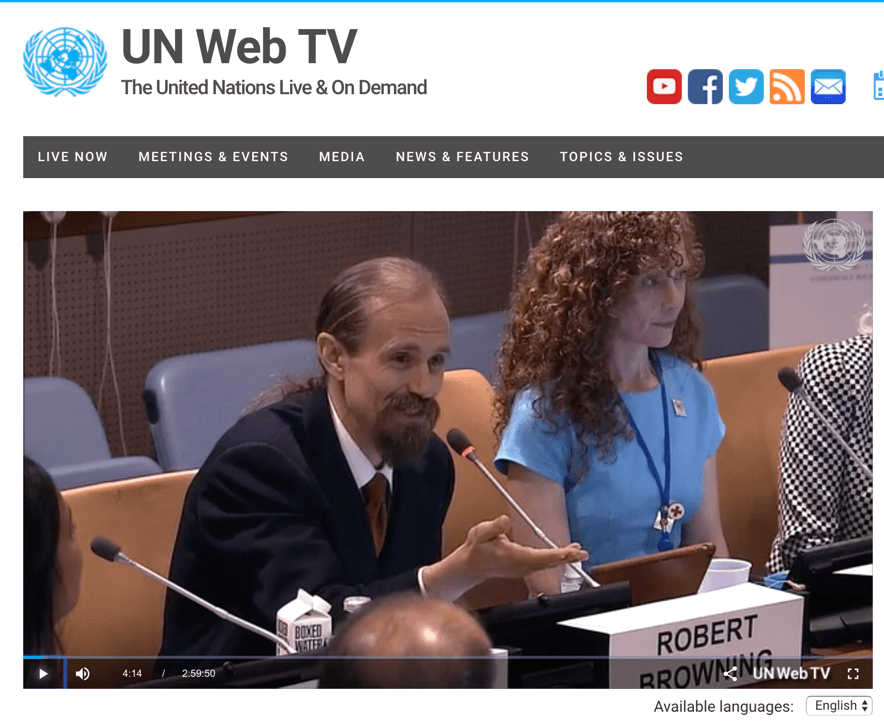
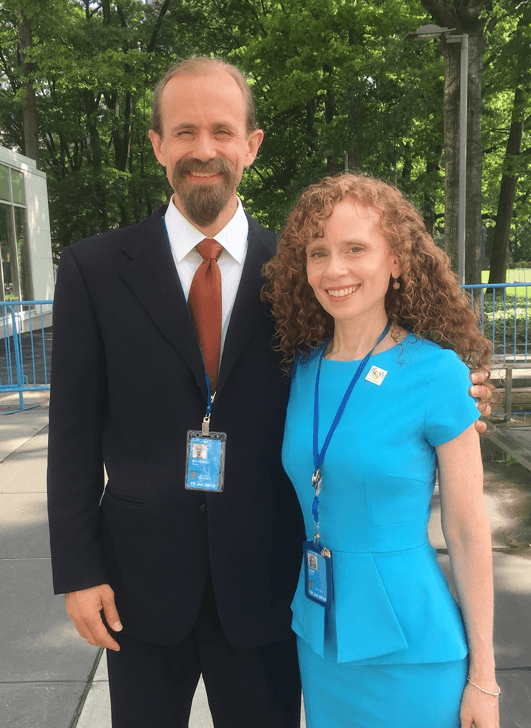
Sheva Carr and Robert Browning, HeartMath co-directors & senior trainers, recently presented HeartMath science and techniques at this event in partnership with Heart Ambassadors, the Business Plan for Peace, Pathways to Peace, and the Center for International Development Law. Together, they provided a platform to discuss practical actions and best practices for empowering individuals through increasing personal coherence and creating peaceful societies through peer-to-peer collaboration and coherence.
The
Division for Sustainable Development Goals, UN Department of Economic
and Social Affairs (UN DESA/DSDG), and the United Nations Institute for
Training and Research (UNITAR) organized this 2019 edition of the
Sustainable Development Goals (SDGs) Learning, Training & Practice –
a series of capacity building and knowledge workshops held at the 2019
HLPF, which featured speakers and experts from academia and other
sectors on crucial topics related to the implementation of the 2019
SDGs.
To see the United Nations resilience/inner peace presentation that Sheva Carr and Robert Browning presented at the HLPF, click here.
It’s harder to sleep in these times. Articles are written every day about the subject. Your reason for tossing and turning at night may be different from mine. But the result is the same. We’re foggy and tired the next day. We keep ourselves alert with coffee, sugar or other stimulants. Then we crash and drag and can’t remember where we left our car keys. Up and down we go. We stay up late to get things done, like “just one-more-email” which stimulates one more. We watch TV to chill before bed but then the theme of the last show we watched takes over our brain and creates restless sleep – if we’re lucky. For many of us, worries and concerns we’ve been pushing aside finally get their time to play out on the stage of our minds without distraction. Where’s that sleeping pill to shut it all off? But that sleeping pill just leaves us dragging again the next day.
We all know the statistics. Not enough sleep affects our emotional well-being, our cognitive clarity, our relationship communications, our performance on the job or elsewhere, our sense of connection to spirit or self, and ultimately our long-term health. We get anxious about not sleeping, which only makes it harder to sleep. Anxiety releases adrenaline which prompts body and mind into action–the opposite of what we need for sleeping. It’s a catch-22. Many of us have tried a lot of the recommended common sense remedies and still often find ourselves lying awake a good part of the night. What are we to do?
If this describes you or someone you care about, there is one place you may not have looked for help that’s about one to two feet under your nose, depending on how tall you are. That place is your heart.
Three Ways Your Heart Can Help You Sleep Better
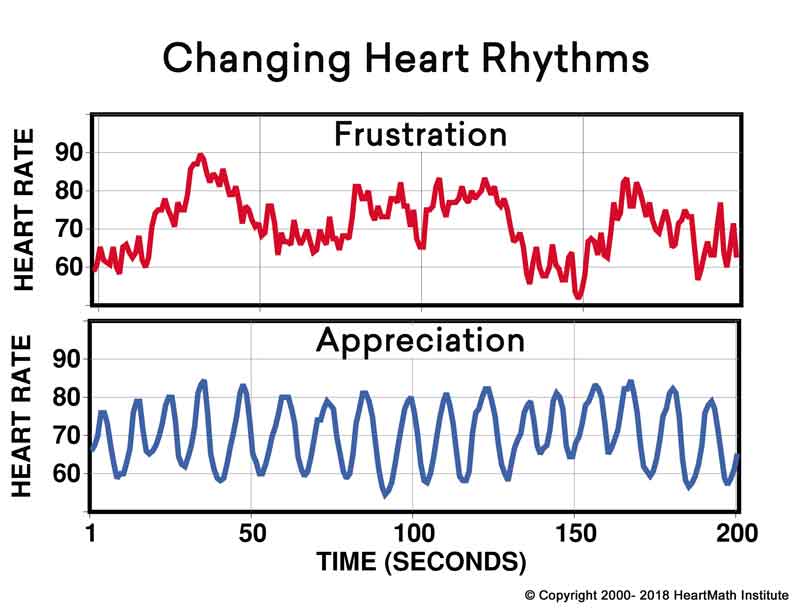
Your heart beats in a rhythm. Research at the Institute of HeartMath shows that when you are worried, anxious, frustrated – stressed – that rhythm becomes irregular. The more stressed you are, the more chaotic your heart rhythm pattern becomes. So what makes the heart rhythm smooth out quickly? Research shows it’s positive feelings, like love, care, gratitude, appreciation, compassion or joy. These feelings not only feel good but are good for you. They order your heart rhythms, reduce cortisol and increase DHEA (the vitality hormone) to help you sleep more soundly and wake up more energized and refreshed.
When your heart rhythm pattern becomes smooth and ordered, it’s called a coherent rhythm. Below is a picture. You can see how jagged and incoherent the heart rhythm pattern is when you’re anxious or frustrated and how smooth and sine-wave like (coherent) it becomes when you’re feeling appreciation.
What’s cool is that both graphs are of the same person feeling one way then the other within a period of a couple minutes. What’s even cooler is that scientists have found that the smooth, coherent rhythm is the pattern your heart rhythm naturally goes into during deep sleep. So why not give it some help? Here’s how you can:
When you close your eyes at night, tell yourself you aren’t going to overdramatize your concerns about sleeping. Here’s a heart-focused technique we call Attitude Breathing® to help create the coherent rhythmic pattern that can facilitate deeper and more effective sleep:
* Gently breathe an attitude of calm, ease and relaxation for a minute or two. * When relaxed, then breathe an attitude of appreciation, gratitude or love for someone or something–a pet, a time in nature, etc.
* Do this for a few minutes or so to activate the heart rhythms that help release beneficial hormones which reduce stress and restore your system.
If you go to bed with that stressed, jagged heart rhythm pattern, it can disrupt your sleeping rhythms. During deep sleep your breathing and heart rhythms are quieter, your metabolic rate slows and hormonal rhythms change. The stress hormones cortisol and epinephrine (adrenaline) decrease. However, when these rhythms are disrupted, then sleeping restfully or waking up refreshed is hard to come by.
Have you ever noticed what happens when you go to bed without resolving a real or imagined conflict with someone? Your mind won’t stop rehashing what you could have or should have said. Your heart can help.
Respect yourself and the other person. If you can, communicate with her before you go to bed and with open-heartedness and latitude, try to work it out. Check to see if there’s something you need to correct within yourself to help the situation. Apologize if you need to and listen from your heart with an attitude of genuine care. Ask questions to sincerely understand where she is coming from, even if you think you know. If you can’t reach the person, talk about the problem with someone who won’t just agree with you but may provide another point of view. Then talk to the person as soon as you can. Don’t chicken out. Even if the situation doesn’t resolve right away, you can release yourself more knowing that you tried. Breathing the attitude of self-compassion has helped many people in “hard-to-resolve” situations.
Realize that what you do during the day also affects how you sleep at night. When you allow stress to build-up during the day, it throws off your body’s rhythms and can lead to overload, headaches, backaches, indigestion, energy drain and more. Your heart generates the strongest rhythm in the body, and your brain and nervous system entrain to your heart’s rhythm, whether coherent or incoherent. This exciting research is available if you want to learn more.
Getting your heart into a coherent rhythm a couple times during the day helps release stress as you go and helps reset your body’s rhythms for better sleep at night. Here’s how.
Take a coherence break in-between activities, at your desk, on a break, or anywhere. Shift focus to your heart (look at picture of a loved one, remember a favorite pet, or recall a time in nature) and feel appreciation or gratitude. It’s important that the appreciation be heartfelt (not just from the mind) to activate heart coherence and hormones that help bring harmony and stability to your mental and emotional processes. Breathe the true feeling or attitude of appreciation through the area of your heart for a minute or two (without mentally multi-tasking as you do this). Taking coherence breaks also increases balance and resilience and helps you listen to your heart’s intuitive guidance on what else you need to do to release stress.
 Your Privacy Choices