
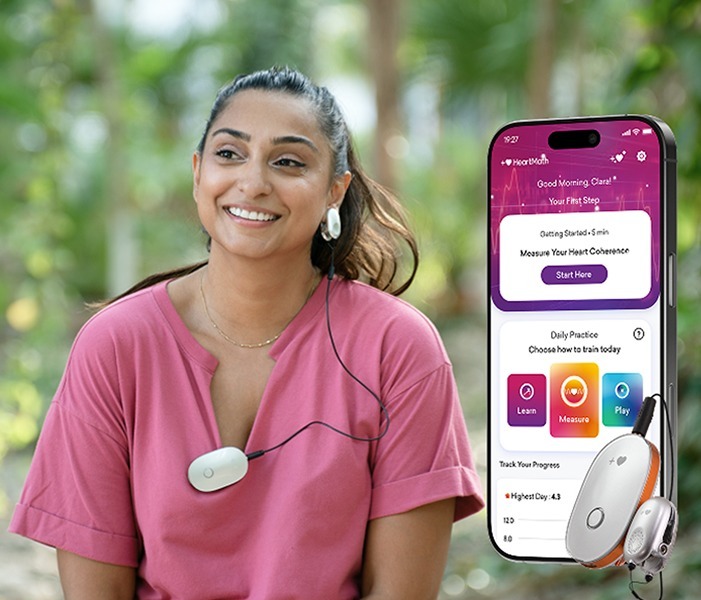

Your heart knows how to calm your mind. We'll show you how.
For 35 years, HeartMath has studied the heart-brain connection.The Inner Balance sensor and HeartMath App turn that science into a simple daily practice that calms your nervous system.
The Research
35 years of heart-brain science.
From stressed to steady — and the data to prove it.
HeartMath has spent over three decades studying heart rhythm patterns (HRV) and the heart-brain connection — research that's been validated again and again, in clinics, hospitals, and everyday life.
How It Works
Three steps. A few minutes a day.
HeartMath makes your heart rhythm visible — then helps you guide your nervous system out of stress and back into balance.
The more you practice, the easier that shift becomes.
Step 1
Measure
Clarity in real time
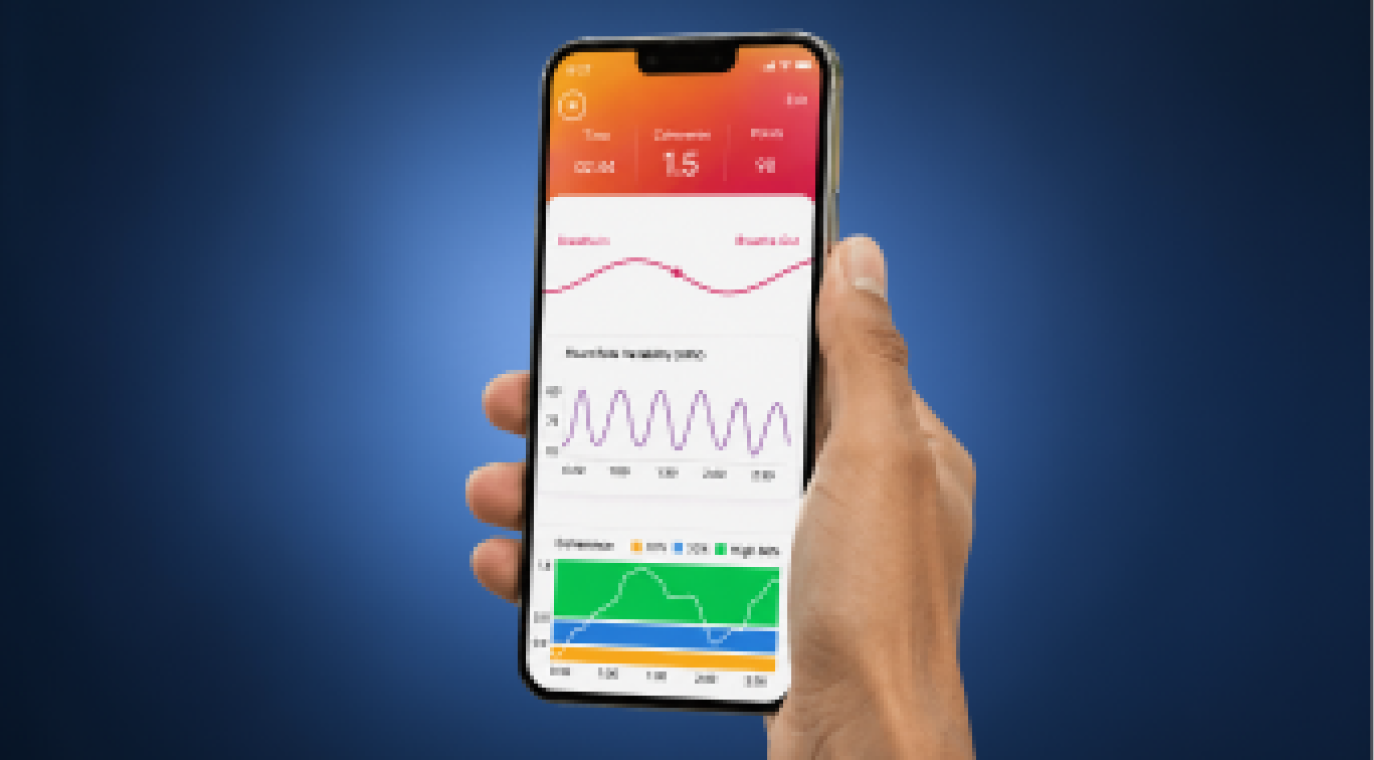
Clip the Inner Balance sensor to your ear. The HeartMath App shows your heart rhythm (HRV) in real time — an honest read on your nervous system, right now.
Step 2
Train
5 min/day or more
Follow a short guided session. As you breathe and shift your emotion, you watch your heart rhythm settle into a smooth, steady pattern — a calm state you can actually see happening.
Step 3
Improve
Calm that lasts
With regular practice, your body gets better at finding calm on its own — steadier focus, better sleep, and more resilience when stress hits.
Resources & Education
Go deeper, at your own pace.
Articles, conversations, and a free course — practical ways to bring HeartMath into your daily life.
For Professionals
Bringing HeartMath into your practice, organization, or team?
Whether you're a clinician, a coach, a hospital system, or an organization investing in resilience — there's a path built for you.
Good questions. Honest answers.
-
Why does HeartMath focus on the heart?
Because that's where the research points. Most stress tools focus on the brain — but the heart sends more signals to the brain than the brain sends to the heart. Those signals directly shape how you think, feel, and respond to stress. Heart coherence — a measurable state of optimal heart-brain communication — is what HeartMath trains. The nervous system benefits are real and documented. But the heart is where the change begins. Explore the science →
-
What is HRV biofeedback?
HRV — heart rate variability is the variation in time between your heartbeats. It's one of the most reliable windows into nervous system health. High HRV means your system is flexible and resilient. Low HRV means it's stuck in a stress pattern. HeartMath's HRV biofeedback takes that measurement and makes it actionable — showing you your heart rhythm patterns in real time so you can see your nervous system responding as you train and learn to shift it on demand. Most people have seen an HRV number. Very few have been able to actually do something with it. That's what HeartMath's biofeedback is built to change.
-
How is HeartMath different from other HRV wearables?
Most HRV wearables — Whoop, Oura, Garmin, Apple Watch — measure your HRV overnight, give you a readiness score, and tell you whether to push or rest. That's useful information. But here's what none of them do: actually train your HRV to improve. They're sophisticated observers. HeartMath is a training system.
Where other devices give you a number to react to, HeartMath gives you a real-time practice that actively shifts your nervous system toward coherence — and over weeks, raises your baseline HRV. Whether your HRV is low and you want to fix it, or high and you want to push it further, the question is the same: are you just tracking, or are you actually training? HeartMath is the only tool built to do the second thing.
-
Does HeartMath work with meditation?
Not only does it work with meditation — for many people, it makes meditation significantly more effective.
Here's why: getting into heart coherence before you meditate primes your nervous system, so you can drop into a deeper state faster and stay there longer. The mental effort of "trying to settle" is replaced by a body that's already settled.
And for the first time, HeartMath's biofeedback lets you see exactly how your meditation is affecting your physiology in real time — whether your practice is moving your nervous system toward coherence or not. Most meditators have never had that feedback. It changes how you practice. HeartMath doesn't compete with meditation. It deepens it.